
Cigar Tobacco
What cigar tobacco is, what its three layers do, and why one cigar can blend leaf from several countries.
What Is Cigar Tobacco?
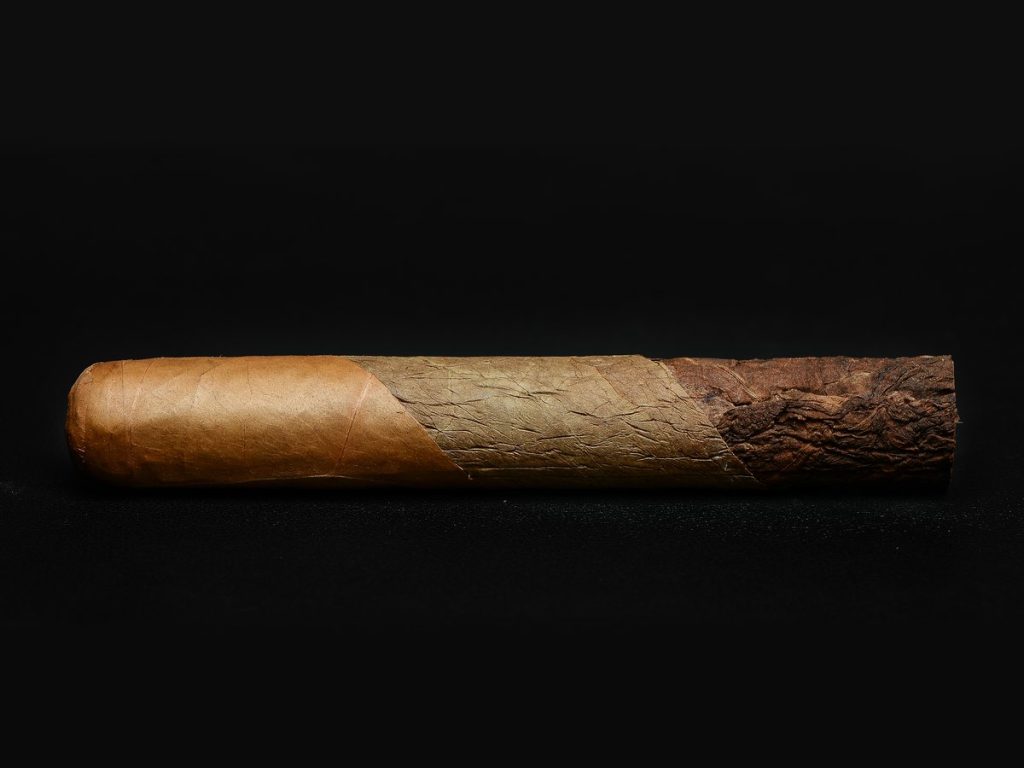
Cigar tobacco is tobacco grown, cured, fermented, and aged to be rolled into cigars. A premium cigar is made from leaf alone, in three layers: a wrapper on the outside, a binder underneath, and a core of filler. There is no paper and no filter, just leaf wrapped in leaf.
What sets it apart is how the leaf is handled. Cigar leaf is usually air-cured in barns and then fermented, a slow process that rounds out the leaf and brings its flavor forward. This page covers the leaf itself: the three parts of a cigar, where on the plant a leaf grows, how its color develops, the seed families behind it, and why we blend leaves from many countries. To see where cigar tobacco grows, visit our tobacco regions page, and for the full journey from seed to smoke, watch How a Cigar Is Made.
The Three Parts of a Cigar: Wrapper, Binder, and Filler
Every premium cigar is built from three kinds of leaf, and each has its own job. The wrapper is the cigar’s face: its look, its texture, and a large share of its taste. The binder keeps the bunch intact and also imparts flavor. The filler supplies the body, the strength, and the balance.
Wrapper (capa)
The wrapper is the outer leaf, the one you see, touch, and taste first. It is the most expensive tobacco in the cigar because it has to be thin, smooth, even in color, and free of blemishes, and because the leaf is delicate enough to tear or mark if it is handled roughly. Your lips and tongue meet it with every draw, so it shapes much of the flavor you taste. That is why a brand will often sell several lines over the same binder and filler and change only the wrapper, such as Connecticut, Habano, or maduro, to get a different flavor. It is not a rule, and every brand builds its lines in its own way.
Before the wrapper is applied, it is moistened to make the leaf more elastic and pliable. The bunch (the binder and filler) is a little drier. Once the wrapper is applied and the cigar passes quality control, it moves on to the aging room. Here, the flavors of the wrapper, binder, and filler marry. The wrapper also dries and shrinks, while the bunch absorbs moisture from the wrapper and from the aging room’s humidity, expanding. The shrinking wrapper and the expanding bunch “lock” the three parts of the cigar firmly together.
Binder (capote)
The binder is the leaf rolled around the filler to hold the bunch together. It is chosen for how it performs rather than how it looks: a sturdy leaf that keeps the shape of the cigar and helps it burn consistently. Many binders were grown to be wrappers and were graded lower because of small flaws in the leaf. Some blends use two binder leaves to add depth.
Filler (tripa)
The filler is the heart of the cigar, the bundle inside the binder. Fine cigars often blend two to five kinds of leaf here, mixing mild, medium, and strong tobacco to set the cigar’s strength and body.
Long filler uses whole, unbroken leaves that run the full length of the cigar, and it is the gold standard. A blender can arrange the leaves so the flavor changes as the cigar burns down. Short filler uses cut pieces of leaf. Its flavor can be good, but it does not develop through the smoke in the same way. We make both, at separate factories in Estelí. Read more about long filler cigars and short filler cigars.
The parts you can see
The outside of a cigar has a few parts of its own. The head is the closed end you cut and put in your mouth, sealed with a cap, a small piece of wrapper leaf. Cut just above the cap line, where the cap meets the body of the cigar, so the wrapper does not unravel.
The foot is the end you light, and most premium cigars leave it open so the filler shows. When the wrapper is folded over the foot instead, the cigar has a “closed foot.” The band is the paper ring near the head that carries the brand, and some cigars add a second band near the foot.
Where on the Plant a Leaf Grows: Volado, Seco, Viso, and Ligero
A leaf’s height on the plant sets how strong it is and how it burns. Premium leaf is usually picked in stages known as primings, from the bottom up, and each level has its own name: volado at the base, then seco, viso, and ligero at the top. The higher the leaf, the more direct sun it gets, the longer it takes to ripen, and the thicker, oilier, and stronger it grows.
Each priming usually takes two leaves from the plant, sometimes three, with several days to a week between passes. Farmers can tell when a leaf is ripe: it breaks off the stalk with a crisp snap. If the snap sounds dull, they leave the leaf for another day or two.
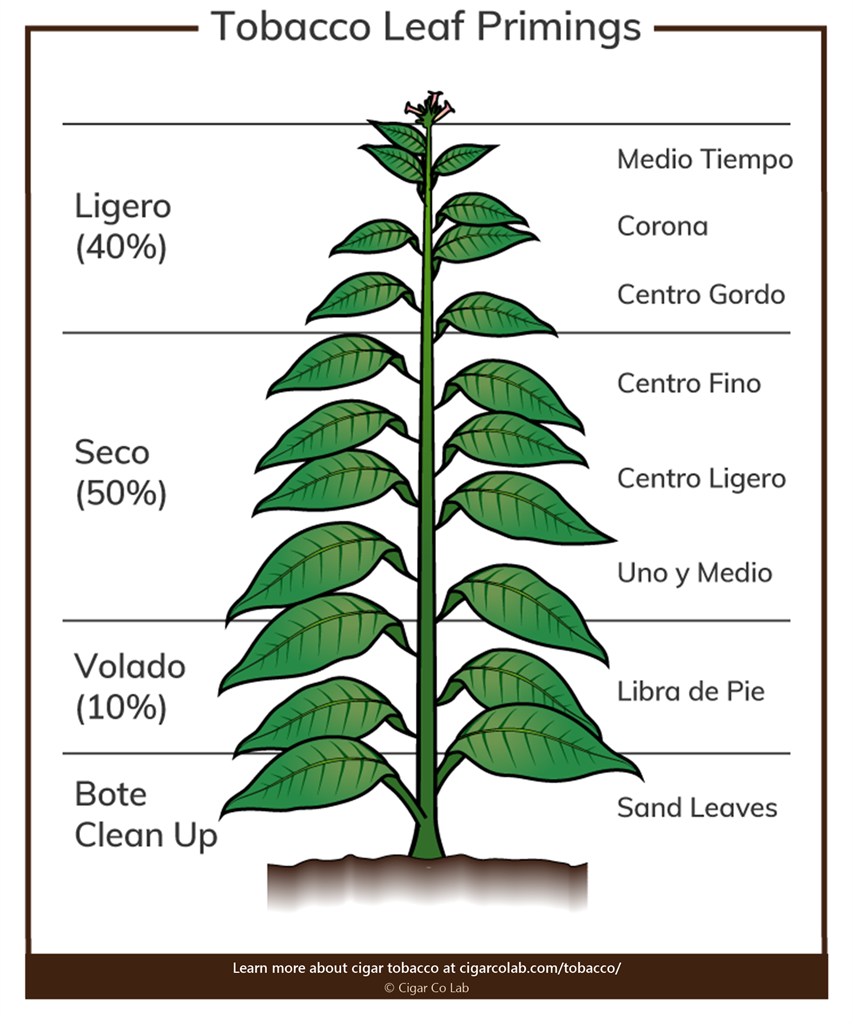
- Volado grows at the bottom. It is light in body and burns easily, so blenders value it more for keeping a cigar lit than for flavor.
- Seco grows in the middle. It is milder and lighter in taste than the leaves above it, and it adds much of the aroma.
- Viso sits a little higher. It is aromatic, and it falls between seco and ligero in strength. Some growers fold it into seco and do not name it separately.
- Ligero grows at the top, in the most sun. It is thick, oily, slow to burn, and the strongest of the main leaves, and it needs more aging than seco. Ligero from Estelí is among the strongest used in cigars.
- Medio tiempo is a rarity. On some plants, two small leaves grow above the ligero. They are thick, rough, and even more potent than ligero, so they go into filler in small amounts.
Growers divide the plant more finely still. In Cuban-style terms, the levels line up roughly like this, from the bottom up: volado is libra de pie (also written libre de pie); seco covers uno y medio, centro ligero, and centro fino; and ligero covers centro gordo and corona, topped on some plants by medio tiempo. On a typical plant, roughly half the leaf is seco, about 40 percent is ligero, and about a tenth is volado.
A blender uses these levels like the dials on a mixing board. Seco and viso keep a cigar smooth and aromatic, volado helps it burn well, and ligero adds weight and a peppery edge. Ligero is potent, so blenders add it in measured amounts. Getting the balance right is a large part of the craft.
Wrapper Shades, from Claro to Oscuro
Wrapper color runs from pale green to near black, and the shades are named in a rough order from light to dark. The names are not standardized, so one maker’s colorado can be another’s colorado claro. Color tells you how a leaf was grown and handled. It does not tell you how strong the cigar is, nor does it alone determine how the cigar tastes.
- Double claro, also called candela: a bright green leaf whose color comes from chlorophyll kept in the leaf by fast drying.
- Claro: a very light tan, beige, or golden brown.
- Colorado claro and colorado: light to medium brown, with a warm tone.
- Colorado maduro: a dark brown between colorado and maduro.
- Maduro: a deep brown that can look nearly black. The name is Spanish for “ripe.”
- Oscuro: among the darkest wrappers, and often oily.
What makes the color
Color comes from several things working together: the seed, how the plant is grown, where the leaf sits on the plant, how it is cured, how long it ferments, and how long it ages. Shade growing is a good example. Wrapper grown under cloth tents tends to be thin, elastic, and light, with a silky texture and a mild flavor. Sun-grown wrapper tends to be thicker, oilier, and often darker, with a fuller flavor. A cloudy climate can do the same work as a tent, which is how Ecuador grows thin wrapper without netting.
Maduro shows how much growing and fermentation matter. Its dark color can come from sun exposure, from a long and hot fermentation, or from both, and the result is often sweeter and oilier than a lighter wrapper. Thick leaves such as Connecticut Broadleaf can ferment for as long as two years.
Four ways to cure a leaf
Curing dries the green leaf and sets its color, and each method gives the tobacco its own character. Cigar leaf is almost always air-cured, and the other three methods mostly serve cigarettes, pipe tobacco, and smokeless tobacco.
- Air curing: leaves hang in ventilated barns, out of the sun, for roughly three to eight weeks. Dark air-cured leaf is the cigar type, and lighter air-cured leaf, such as burley, goes into cigarettes. Some curing barns have pits in the floor for small fires, which warm the air and lower the humidity, and when the air is too dry, water can be spread across the floor to raise the humidity. Large doors at each end and shutters along the sides control the airflow, so the climate inside the barn can be kept right for the leaf.
- Flue curing: leaves are heated in a closed barn for about a week. They come out bright yellow to orange-brown and high in sugar, and they go into cigarettes and pipe blends.
- Fire curing: leaves hang over a smoldering fire for several weeks, which makes them dark, heavy, and oily, with a strong, pungent smoke. They go mainly into snuff and chewing tobacco, and some into pipe blends.
- Sun curing: leaves dry in direct sun for one to two weeks. This is how Oriental tobacco is usually cured, and it goes mainly into cigarette and pipe blends.
Seed Families: Cuban, Connecticut, Sumatra, and Broadleaf
Four seed families come up again and again in cigar tobacco, and three are named for where they began. A seed sets a leaf’s potential, including how thin it is, how elastic, and which notes it can carry. The soil, the climate, and the way the leaf is cured then decide how much of that potential comes through.
Cuban seed
Cuban seed is the family behind a great deal of Central American cigar leaf. It includes the Habano types, a traditional Cuban line since crossed into many modern varieties, and Corojo, a variety Cuban growers developed during the 1930s and 1940s and no longer grow. Piloto Cubano, used mainly as filler, is another. After the 1959 revolution, growers carried this seed to Nicaragua, the Dominican Republic, and Honduras. Leaf from Cuban seed tends to be rich and aromatic, and darker when it is grown for wrapper. Nothing we make contains tobacco grown in Cuba, and you can see how the legal descendants compare on our Cuba page.
Connecticut seed
Connecticut seed, which descends partly from Sumatra seed, grows a thin, silky wrapper with a mild, creamy flavor, a classic choice for gentler cigars. Today most of it comes from Ecuador, and only a small amount is still grown under cloth shade tents along the Connecticut River. See the USA and Ecuador pages.
Sumatra seed
Sumatra seed began in Indonesia and makes an elastic wrapper like Connecticut’s, but it can carry noticeably more flavor. Depending on how it is fermented, it can run from claro to maduro. The seed now also grows in Ecuador and Mexico, and the toothy wrapper of Cameroon traces back to it too. See Indonesia for where it started.
Broadleaf
Broadleaf is a large, thick, hardy leaf that ripens in the open sun. Instead of picking it leaf by leaf, growers cut the whole stalk at the base. The thick leaves ferment for a long time, and they become the dark, sweet, earthy wrappers behind many maduro cigars. Connecticut Broadleaf is the best known, and you can read about it on our USA page.
Why We Blend Tobacco from Many Countries
No single country grows every leaf a great cigar could need. One origin grows a pale, silky wrapper, another a toothy leaf with spice and cedar, another a dark, sweet coat for maduro, and others the strong, earthy filler that gives a cigar its backbone. A blender who works from one country is painting with a smaller box of colors (though many blends, known as puros, use leaf from a single country).
A blend works like a piece of music. The filler is the rhythm and the harmony, the weight under every note. The binder keeps time, so the cigar burns the way it should. The wrapper is the melody, the first thing you hear and the last thing you remember. When one part is out of tune, you notice. When they play together, you stop noticing the parts at all.
Every one of our blends draws on the leaf that suits it. Clients who want the taste of a Cuban cigar can ask for a homage blend, which uses leaf from other countries to come close to it.
Thinking about launching a line? Learn how to start a cigar brand, see how we make custom cigars, or begin with a factory blend.
Cigar Tobacco Questions
What is the difference between cigar tobacco and cigarette tobacco?
Cigar tobacco is handled differently. Cigar leaf is dark air-cured and then fermented, and it is wrapped in leaf, not paper. Cigarette tobacco is usually flue-cured or light air-cured, like burley, and it is not fermented.
The two also differ in size. A cigarette holds less than a gram of tobacco and is usually finished in under ten minutes. A large cigar holds from about 10 grams of tobacco in a slim lancero to about 20 or more in a thick gordo, and it can take one to two hours to smoke.
Does a darker wrapper mean a stronger cigar?
No. Wrapper color comes from the seed, growing conditions, curing, and fermentation; it does not measure strength. Strength depends mostly on the leaves in the filler, so a dark maduro wrapper can sit on a mild blend, and a pale claro wrapper can sit on a strong one.
Which country grows the best cigar tobacco?
None wins every category. Each region is strongest at a different task, and some are known for wrapper while others are known for binder or filler. Our tobacco regions page profiles twelve countries of origin and what each one does best.
Three Leaves, One Cigar
- Wrapper: the outer leaf, and a large share of the flavor
- Binder: keeps the bunch in shape and helps it burn evenly
- Filler: the heart of the cigar, setting strength and body
- Leaf height: volado burns, seco smooths, ligero adds power
Where to Next
Tell Us About the Cigar You Want to Make
A 30-minute conversation is enough to scope your blend, your packaging, and your real timeline. No pressure, no deposit, just straight answers from the people who’ll actually make your cigars.
We answer every serious inquiry within one business day.