
Masatepe Tobacco: The Native Chilcagre
A native Nicaraguan black tobacco, still grown in Masatepe: planted in the rainy season, cured in the sun, and fermented in pits in the ground.
The Black Tobacco That Was Here First
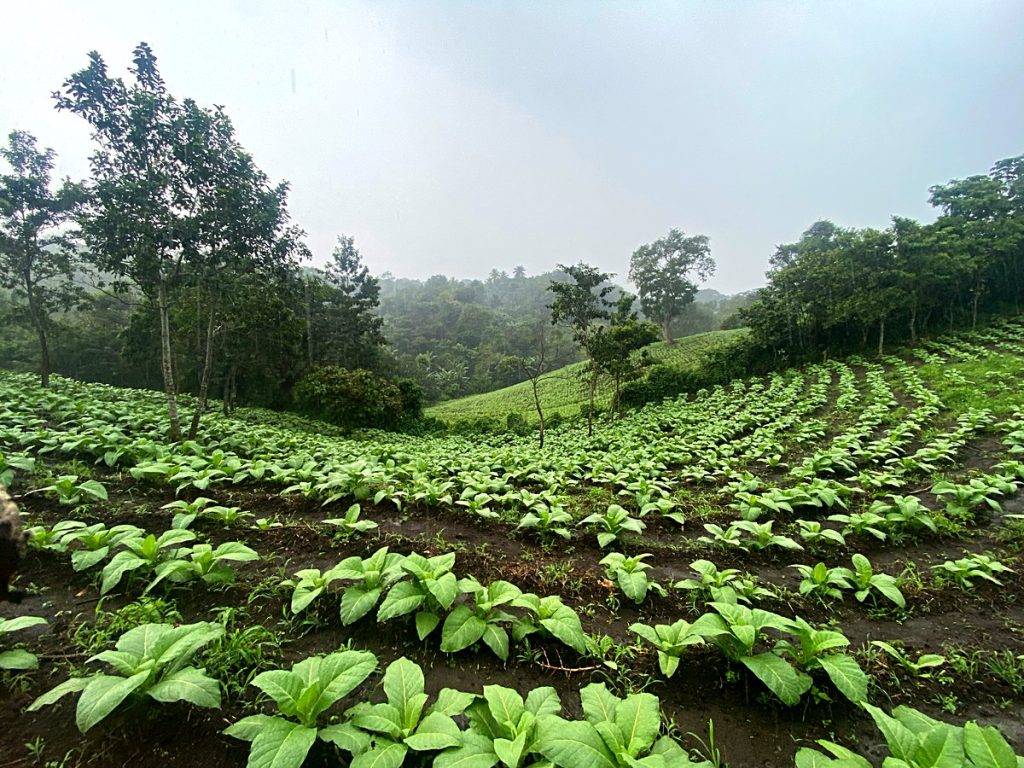
Chilcagre is the traditional Nicaraguan name for an old native tabaco negro, or black tobacco. Nicaragua’s tobacco laws were already setting planting quotas for it by the 1860s, almost a century before Cuban growers arrived in the north. The leaf we use comes from Masatepe, a town in the department of Masaya. It grows in the rainy season, cures in the sun, and ferments in pits dug into the ground, and it tastes like nothing else we blend with.
For many years we have worked with three Masatepe growers, and we have photographed their work from the field to the pit. The history on this page comes from published sources and Nicaragua’s old tobacco laws. The growing, curing, and flavor notes come from our own time with those growers.
What is Chilcagre tobacco?
In Nicaragua, Chilcagre is the name for an old, native criollo tobacco with a strong, dark leaf. The Diccionario de americanismos, the Spanish-language dictionary of Latin American usage, defines it simply as a black criollo tobacco with a slightly peppery bite. In Spanish, tabaco negro (black tobacco) is the term for dark leaf, strong in flavor and aroma, as opposed to the light tabaco rubio.
Chilcagre is not a registered modern seed variety like Criollo 98 or Habano 2000, which were bred by crossing selected lines. As far as we know, it has no seed bank entry and no commercial seed to match it. When a 1948 law freed its planting, it called it simply “the common variety known as Chilcagre.”
How old is Chilcagre tobacco?
Tobacco was here long before the cigar trade. Indigenous peoples across the region used it in ceremonies and as medicine, and local tradition holds that Chilcagre comes down from the tobacco they grew before Spanish rule began in the early 1520s.
In 1766, under Spanish rule, the Crown made tobacco its monopoly, and growing it needed official permission. After independence, the state kept control of the crop, and its records name Chilcagre again and again:
- 1869: the government licensed one million Chilcagre plants in the Masaya district and graded the leaf as first or second class.
- 1873: a decree set three and a half million Chilcagre plants for Masaya and the town of Masatepe.
- 1893: that year’s six million Chilcagre plants were split between the two, four million for Masaya and two million for Masatepe.
- 1933 and 1935: a 1933 law made Chilcagre harvests pay the planting tax before they could be sold, and a 1935 law taxed small Chilcagre cigars at half the rate of other cigars, until a 1939 law exempted them.
- 1934 and 1937: a 1934 law banned planting Chilcagre for 1934 and 1935 everywhere but Nueva Segovia, and a 1937 law banned it again for up to three years.
- 1950: under a 1948 law, growers were free to plant it again from April 1950.
So Chilcagre was a recognized crop, licensed, graded, taxed, and at times banned, long before Nicaragua’s modern cigar industry took shape.
Why Masatepe?
Masatepe is where the leaf we work with comes from, and the planting laws of the 1800s set Chilcagre’s quotas there and in Masaya. Chilcagre was never limited to one place, though. It was also grown around Estelí, where it was rolled into cigars by the early 1940s, and growers on Ometepe planted it too.
Masatepe sits outside the northern cigar belt. Nicaragua’s premium cigar industry took shape in Estelí, Condega, and Jalapa in the 1960s, led by growers and cigar makers from Cuba, and Masatepe tobacco rarely appears in cigar writing. Nobody brought Chilcagre in. It was already there.
Nicaragua’s cigar story is usually told from the arrival of those Cuban growers. Chilcagre’s story began long before. We are not reviving a lost tobacco: the tradition survived in Masatepe, and our growers carry it on today.
Where is Masatepe, Nicaragua?
Masatepe is a town in the department of Masaya, about 50 km (31 miles) south of Managua. It sits on the Meseta de los Pueblos, a plateau of old towns about 450 to 500 meters (roughly 1,500 feet) up, cooler than the lowlands around it. Most of the town stands on level ground that drops steeply toward the Laguna de Masaya, the lake beside the Masaya volcano.
The soils formed from volcanic ash and are fertile and well drained. The rains run from about May to October, and the average temperature sits around 24°C (75°F).
The name is usually read as Nahuatl for “deer hill” or “place of deer.” Masatepe has long been coffee country, and today it grows fruit as well. The town is known across Nicaragua for its handmade wood and wicker furniture and for sopa de mondongo, a tripe soup. The old railway station is now a crafts and furniture market, and each May or June the town celebrates its main fiesta, the Santísima Trinidad.
A low plant with narrow leaves
Chilcagre plants grow low, with narrow leaves. They look nothing like the tall, broad-leaf varieties in the fields around Estelí. To us, that points to an old, unimproved landrace, which botanists define as a local variety with deep roots in its place, kept by farmers rather than reshaped by breeders.
Cuba’s modern hybrids were bred for disease resistance, higher yields, and larger, better-shaped leaves. Chilcagre looks as if it never went through any of that.
How is Chilcagre grown and fermented?
Most of the process in Masatepe runs against the usual way of growing cigar tobacco in Nicaragua:
- Native seed: the old local Chilcagre, not a modern bred variety.
- Volcanic soil: dark, rich ground formed from volcanic ash; our growers usually plant on slopes so the heavy rain drains away.
- Rainy season: sun grown in the wet months, for the deepest flavor.
- Sun cured: dried in the sun, out in the field, not hung in a barn.
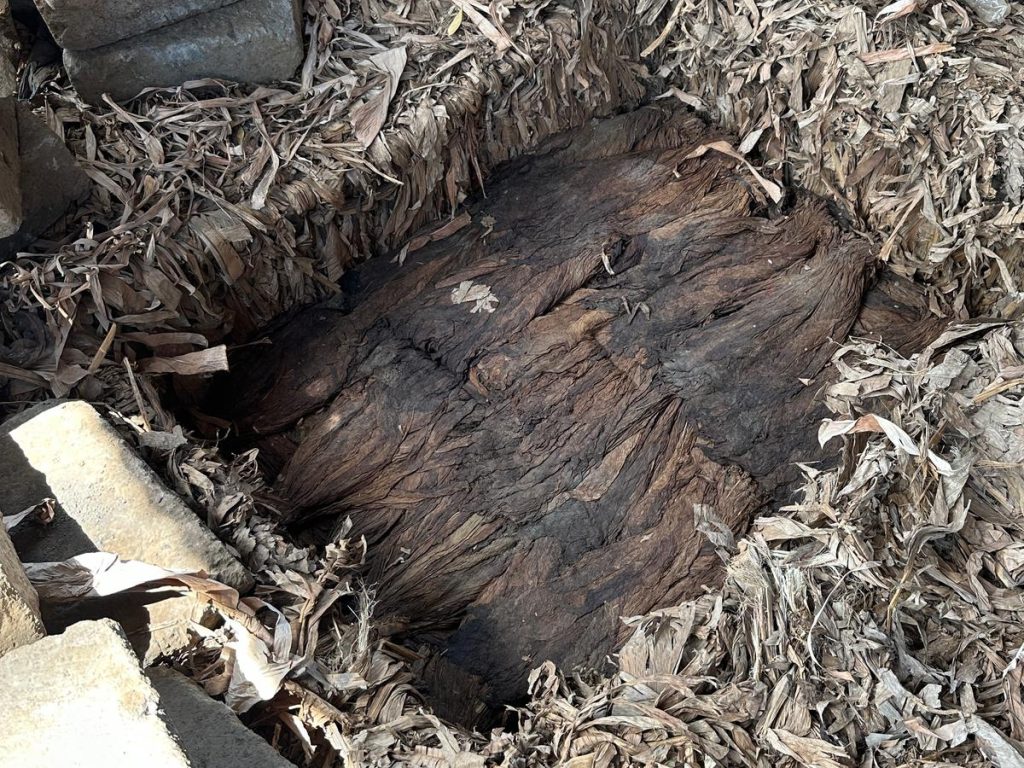
- Pit fermented: 15 days or more in the ground, under heavy weights, with a process our growers keep to themselves.
- Finished at our factory: a further fermentation before rolling, when the leaf needs it.
Grown in the rainy season
Most cigar regions prefer to grow with controlled irrigation, so the grower decides how much water each field gets. Chilcagre is the exception. It does not mind the rain, and it is actually better grown in the wet months, which is when the leaf builds its strongest flavor.
Cured in the sun, fermented in the ground
After the harvest, the leaf cures in the sun, out in the field, while most cigar leaf hangs in a curing barn for several weeks. Then Chilcagre goes into a pit dug in the ground and lined with palm leaves, where it ferments for 15 days or more under heavy weights. We call it pit fermentation, or in Spanish, fermentación en hoyo. Each grower has a setup of their own, and we have photographed several.
The method has a few distant cousins. Dominican andullo is cured leaf rolled in yagua, the large leaf sheath of the royal palm, and bound with rope that is pulled tighter several times as the leaf rests and ferments, until it forms a long, hard cylinder. It is made in the Cibao in the north and around Azua in the south, and it is cut for pipe smoking, chewed, and sometimes blended into cigars. Its makers, the andulleros, gave their name to the Charge of the Andulleros at the Battle of Santiago in 1844, during the Dominican war of independence.
Louisiana perique comes from St. James Parish, along the Mississippi River. The leaf is stemmed by hand, tied into bundles, and packed into barrels kept under heavy pressure with jacks, where it ferments in its own juice for months, often a year, and is taken out, aired, and repacked more than once along the way. Tradition credits the Choctaw with first pressing tobacco in hollow tree trunks. Strong and peppery, it is rarely smoked on its own, so it is mixed with other leaf, mainly in pipe blends, to add spice and depth.
All three ferment the leaf under pressure, but Chilcagre is the only one that goes into the ground. The pit gives it a funky, almost blue cheese aroma, one that normal fermentation strips out completely.
What does Chilcagre taste like?
Chilcagre is a strong, dark filler tobacco, almost black in color. In our experience, it stands apart in three ways:
- Richness: deep, rich undertones beneath the strength.
- A resin feel: a thick, resinous texture in the mouth.
- The aroma: the funky, almost blue cheese note from the pit.
It is immediately identifiable in a blend, yet used well, it complements the other tobaccos rather than overpowering them. The flavor is unique, and the fermentation behind it is very hard to get right.
How we blend with Chilcagre
Straight from the pit, Chilcagre can be very strong and pungent, so we can finish it with a further fermentation at our factory before it is rolled. It also mellows over time. Some smokers prefer its punch fresh and others prefer it smoother, so it can be a good tobacco for aging. Either way, the richness stays.
We used it in a limited-edition cigar for a historic cigar club’s anniversary week, and the members received it extremely well.
Andrius’s favorite tobacco
Chilcagre is the favorite tobacco of Andrius Petručenia, one of our team. For his birthday, we made two special cigars for him, both with 100% Chilcagre filler in an aged binder. One wore a Connecticut wrapper and the other a Habano wrapper, and we rolled 100 of each, 200 in all. Both were flavor bombs, full plus in strength, and were greatly enjoyed by all.
Limited crops, planned ahead
We pay our three growers for each crop in advance, knowing it may not ferment into the taste we need. Getting the conditions right is as much luck as it is art and science, so Chilcagre is costly, limited, and not always available.
To use it in a core line, plan well ahead or wait for a limited edition. Brands can prepay for a share of a future crop, and so can collectors who want to create their own cigar blend. We also keep a notification list for when a crop gives us a commercial quantity that meets our standards. To be on it, ask about the next Chilcagre crop.
Where It Fits
- Filler: dark, resinous richness that complements a blend
- Character: strong and funky, easy to pick out in a blend
- Supply: small, prepaid crops from three growers
Where to Next
Tell Us About the Cigar You Want to Make
A 30-minute conversation is enough to scope your blend, your packaging, and your real timeline. No pressure, no deposit, just straight answers from the people who’ll actually make your cigars.
We answer every serious inquiry within one business day.